
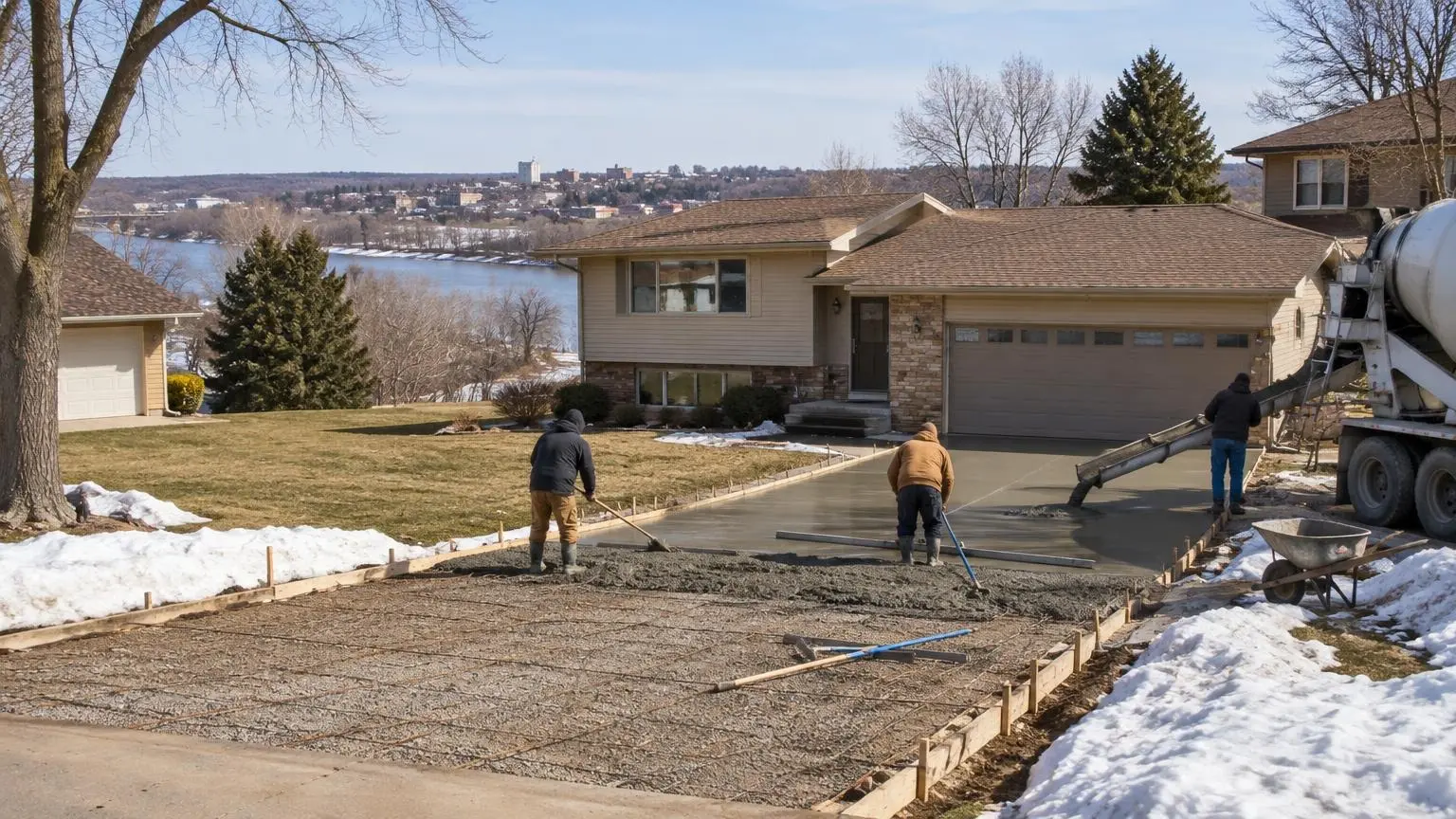
New, wider and replacement driveways
Concrete Driveways in Sioux Falls, SD
Built to drain, to carry a loaded pickup, and to come out of every spring flat and intact.
- Free estimate at your property, with the slab measured and the base checked
- Itemized price in writing, agreed before any demolition starts
- Exterior mixes, joint layout and curing chosen for freeze-thaw and road salt
Driveways That Survive the Plow and the Thaw
Concrete driveways in Sioux Falls take more abuse than almost any other slab on the property. They carry vehicles every day, get scraped by shovels and plow blades, collect salty slush that drips off cars all winter, and freeze solid for weeks at a time. When a driveway fails here it is usually for one of three reasons: water got under it, the mix could not handle freeze-thaw, or cracks had nowhere planned to go. Each of those is decided before the first truck of concrete shows up.
Signs it is time for a new driveway
- Panels that have sunk or tipped so water runs toward the garage or house
- A surface that is flaking, pitted or showing loose stone, especially near the garage door where salty slush drips
- Cracks that keep widening, or cracks where one edge now sits above the other
- A slab that heaves up in winter and settles back in spring
- Broken edges along the lawn where the slab was never thickened
- An old driveway that is simply too narrow for the vehicles you own now
A few hairline cracks are normal. Settled or scaled panels across much of the driveway usually mean replacement costs less over time than repeated repairs.
Tear-out and the base underneath
On a replacement the old slab is broken up and trucked off first, and then we study what it was sitting on. Many older driveways sit on little more than native soil. We remove soft or organic material, add a granular base, and compact it in lifts. The base is graded so the finished slab falls away from the garage and house. A driveway that drains well in April is the one that does not heave in January.
Thickness and reinforcement
HomeGuide recommends at least 4 inches for standard vehicles and 5 to 6 inches for heavier ones, with thicker edges of 6 to 8 inches. In practice we look at what will park there. A family car and a minivan are fine on a properly built 4-inch slab; a three-quarter-ton pickup, a camper or a trailer on the pad calls for more. Rebar or wire mesh does not stop concrete from cracking, but it holds cracks tight so the panels stay level. We tell you what we plan to use and why.
The mix, the joints and the finish
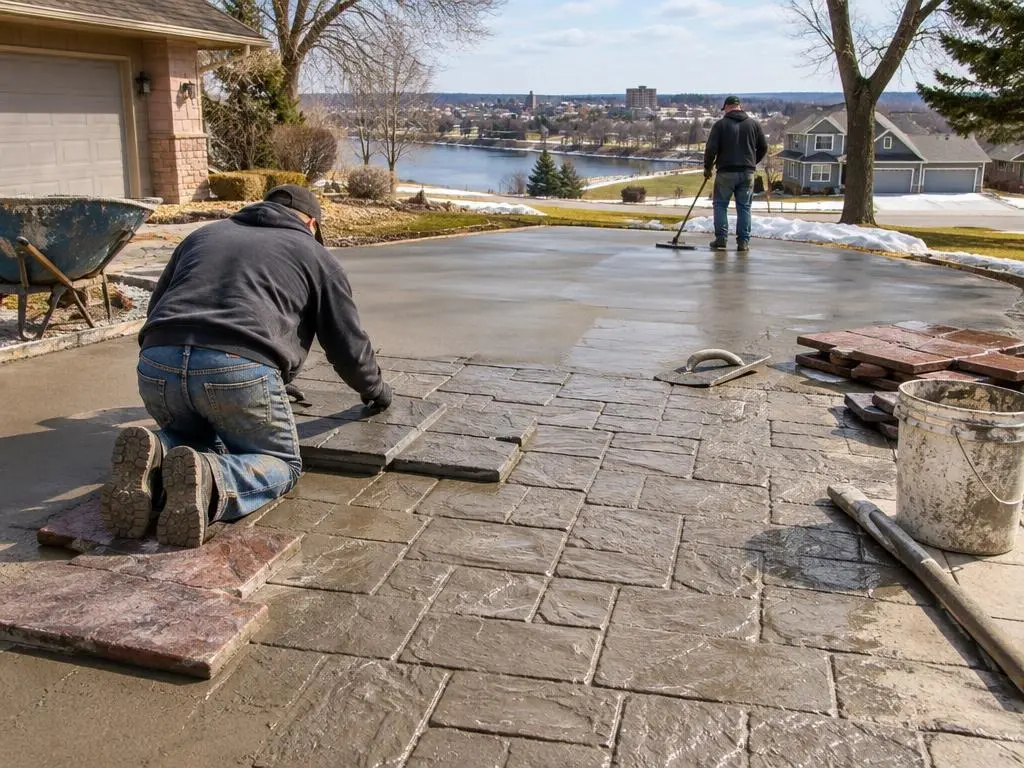
Every exterior driveway gets air-entrained concrete, ordered with the strength and slump we need and placed without watering it down on site. Control joints are laid out before the pour, usually aligned with the garage door edges and spaced so each panel is close to square, then tooled or saw-cut to roughly one-fourth of the slab's thickness. A broom finish across the slope gives grip on snowy mornings. If you want something dressier, a stamped or colored border along the edges is a common option that keeps the main drive simple.
Care through the year
Keep vehicles off a new driveway until we say it is ready, usually about a week for cars and longer for heavy trucks. Do not use any de-icer the first winter. After that, shovel early, use sand for traction, and keep chemical de-icers to a minimum. Seal the driveway with a penetrating sealer once it has cured, and re-seal every few years. Fill small cracks before winter so water cannot get in and freeze.
What a Driveway Job Includes
A driveway project covers everything from the garage slab edge to the street approach or the end of the private drive.
Tear-out and haul-away
The old slab, concrete or asphalt, broken up, loaded and hauled away.
Subgrade and gravel base
Soft soil removed, granular base placed and compacted, and the grade set to drain away from the house.
Forms, thickened edges and reinforcement
Forms set to line and slope, edges thickened, and rebar or mesh placed on supports where the slab needs it.
Air-entrained pour and broom finish
Exterior-grade concrete placed, struck off, floated and broomed across the slope for traction.
Control joints and curing
Joints tooled or saw-cut on a planned layout, then the slab is cured and kept from freezing.
Widening and extensions
Extra width for a third vehicle, a side pad for a trailer, or a turnaround, tied into the existing slab.
Typical Concrete Driveway Costs
| Item | Published range |
|---|---|
| Installed, per square foot | $6 to $15 |
| One-car, 12 x 24 ft (288 sq ft) | $1,700 to $4,300 |
| Two-car, 20 x 20 ft (400 sq ft) | $2,400 to $6,000 |
| Two-car, 24 x 24 ft (576 sq ft) | $3,500 to $8,600 |
| Three-car, 24 x 36 ft (864 sq ft) | $5,200 to $13,000 |
| Old driveway removal, per sq ft | $2 to $6 |
| Rebar, per sq ft | $1 to $3 |
| Sealing, per sq ft | $1 to $3 |
National ranges from HomeGuide's concrete driveway cost guide. Sioux Falls prices can differ, and removal, access, base work and the finish you choose all change the total. Your written estimate is the price.
A Driveway Job, Step by Step
1. Site visit
Measurements, slope and drainage are checked, the vehicles that will use it noted, and the old base inspected.
2. Tear-out and base
The old slab is removed, soft soil dug out, and new gravel compacted and graded to drain.
3. Forming and placement
Edges are formed and steel set on chairs, then air-entrained concrete is placed and broomed.
4. Joints and cure-out
Joints go in on the planned layout, the slab cures, and you get dates for driving on it and sealing it.
Concrete Driveways Questions
How thick should a driveway be in Sioux Falls?
HomeGuide's driveway guide calls for a minimum of 4 inches under ordinary cars, 5 to 6 inches where heavy vehicles park and 6 to 8 inches at the edges. We match thickness to what will actually sit there, pickups, campers and trailers included.
How soon can I drive on a new driveway?
Cars can usually go on after about a week, depending on temperature and the mix. Heavy trucks should wait longer. We give you dates for your slab.
Is it possible to replace only the bad part of a driveway?
Yes, when the failed panels are bounded by joints and the rest is sound. We cut along the joints, replace those sections and pin them to the old slab with dowels or tie bars. Expect a color difference at first, since new concrete starts out lighter.
Do I need a permit for a new driveway in Sioux Falls?
The City of Sioux Falls says the driveway approach, the part in the public right-of-way, may only be repaired by a bonded, insured contractor registered with the City, and its sidewalk permit covers that work. For the part on your own lot, we check what your project needs before we start.
Does a new driveway need sealing?
It is worth doing once the concrete has cured. A penetrating sealer slows the water and salt soaking into the surface. HomeGuide lists sealing at about $1 to $3 a square foot; plan to repeat it every few years.
Concrete Driveways Service Areas
- Concrete Contractors in Sioux Falls, SD
- Concrete Contractors in Brandon, SD
- Concrete Contractors in Harrisburg, SD
- Concrete Contractors in Tea, SD
- Concrete Contractors in Hartford, SD
- Concrete Contractors in Crooks, SD
- Concrete Contractors in Renner, SD
- Concrete Contractors in Dell Rapids, SD
- Concrete Contractors in Baltic, SD
- Concrete Contractors in Garretson, SD
- Concrete Contractors in Colton, SD
- Concrete Contractors in Valley Springs, SD
- Concrete Contractors in Lennox, SD
- Concrete Contractors in Worthing, SD
- Concrete Contractors in Canton, SD
- Concrete Contractors in Humboldt, SD
- Concrete Contractors in Beresford, SD
- Concrete Contractors in Luverne, MN
- Concrete Contractors in Chancellor, SD
- Concrete Contractors in Shindler, SD
Get a Concrete Driveways Estimate
Free on-site driveway estimates across Sioux Falls and nearby towns.